
Non productions can make 16mm optical negative (or positive)
soundtracks directly from most any computer file format, although the preferred
format is 48K/24bit SDII, AIFF or Broadcast.wav - or from 16mm or 35mm magnetic
film formats. We can also work from video or digital audio tapes, but we
certainly prefer not to. We are NOT making electroprints anymore.
IMPORTANT words to lower expectations:
Making acceptable optical soundtracks in 16mm is not trivial. Most
of the people who really knew how to do this are dead. Here are some of the
reasons why it is not so easy and that you should consider before you mix a
film for 16mm:
• 16mm optical sound is one of the most limited sound formats ever
invented, possibly only surpassed in its lousiness by the wire recorder or the
‘bake-lite’ cylinder.
• The frequency response is about 50cps to 6500cps, no joke. You
have better intelligibility ON THE PHONE, because the lo-frequency ‘mud’
content is removed in phone transmissions.
• The ‘dynamic range’ and ‘signal to noise ratio’ is about 30 or
even 25db. This means that your cricket noises or your subtle classical music
passage WILL LIKELY DISAPPEAR. It is barely an exaggeration to say that
EVERYTHING you want your audience to hear, needs to be at MAXIMUM operating
level – NO KIDDIN’. You cannot copy your 85db dynamic range digital recording
to such a format without losing EVERYTHING between –25 and –85db.
• There is NO headroom. Maximum operating level means 100%
modulation, the optical modulations can only get as wide the land they occupy
on the film. If they exceed this physical space, the sound COMPLETELY
disappears. The maximum operating level is determined by the loudest sound in
your mix. Everything else will sit where is lies, relative to this max. This
can make it seem like the bulk of the track is very low.
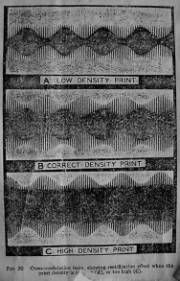
• The exposure of the soundtrack negative and the exposure of the
print and the processing of both are absolutely CRITCAL. And so is the evenness
for which the width of the soundtrack exposure is made, as well as the
application of a special extra developer applied (still done in 16mm) to
the sound track area, known as application, to increase the contrast.
Correct determination of these parameters is only achieved by rigorous testing,
consistency in lab-work and such tests (cross-modulation tests) have to be
repeated often, as film emulsions and chemistry change. In recent years, it has
been increasingly difficult to find lab workers who have much understanding of
these issues. It doesn’t help of course that economics and environmental
concerns are killing the manufacturing of film.
• The ‘small gauge’ area that 16mm track occupies is really very
small. The same logic applies with the size of hairs in the picture aperture,
dirt on the soundtrack neg has more of an impact on the extraneous noise than
in larger format films. I’ll avoid commenting about the quality of lab-work
here, suffice it to say that it is not trivial to avoid some level of dirt on
the neg, therefore white spots in prints and therefore occasional clicks and
pops in the soundtrack. DO NOT expect that this type of noise can be
eliminated.
YOU HAVE BEEN WARNED!
And now, to our disclaimer:
In the event that problems arise with any aspect of production, and claim is made that non productions is responsible for such problems, non will consider the evidence in presented materials and will make reasonable judgment on the matter. Only if non decides that there is in fact a defect in workmanship performed by non or in materials procured by non, will non replace the raw materials and/or re-perform said services at non’s expense. Under NO circumstances will non be responsible for any other loss in following production tasks such as composite printing, even if it is deemed by non to be a result of non’s negligence. It is the responsibility of non clients to examine the work of non and its affiliated laboratories before resuming the production process.
Engagement
of any non service indicates the acceptance of the above stipulations.
Synchronization and other details:
The digital revolution has introduced advantages and
disadvantages, to state the obvious. I don't know how many thousands of times
I've heard things like - the sync should be fine… …we just did this and that
in this app and then blah blah…
…can’t we just…
I’ll try to explain what is clear as mud:
The sync reference is widely misunderstood, but we generally
consider mixes either of film or NTSC video domain, 60hz/24fps or 59.94hz/29.97fps,
and either apply (or do not apply) a playback compensation or
"pull-up" to video domain items, running them faster by a very small
percentage. You can investigate the duration modifications of films or
soundtracks in NTSC video state by multiplying it’s exact length in frames by
either .9989 or by 1.0012, depending on which direction you are crossing the
film/NTSC border. In other words:
A 24fps film of 4000 frames (2m46.667s) will be 4008 frames long
after proper NTSC telecine. A useful film calculator utility is here.
Other insurance procedures:
• Put 'beeps' at both ends in the sound and corresponding to
something in the picture.
• Put the first flash/beep set in a synchronizer at 00'01frms and
note where the end flash/beep set lands
• Submit this measurement with your mix
If is comes to it, we can make mag reference copy (in the same
sync state as we intend to make an optical version) and then check that the
beeps fall where you intend, for example:
An audio file delivered to us of 34m15s21fms, as 24fps material,
will create a sprocketed film (mag or optical) in 16mm that is 1233feet21frms.
Insure that the lab you plan to work with can process D97 or equivalent
B/W positive films, although it is possible to process tracks somewhere besides
at your composite lab, of course.
To make a track neg for you, we will need to know:
• the desired wind (the picture printing element emulsion
position).
• the stock you intend to print to
• the lab you intend to process the track neg
• the lab you intend to print and process the composite
• the sync reference state of the mix, 60hz/24fps or
59.94/29.97fps